Waymo Hasn't Launched One Ride in Portland. It's Already Losing the Argument.
Tellagence Discover audited 11,900 records tracking public sentiment ahead of Waymo's Portland launch.
The headline finding: before a single passenger has taken a ride, the city's sentiment is already split almost evenly — 37% positive to 32.7% negative — because Portland inherited San Francisco's entire backlash playbook before Waymo even filed for a permit.
UPDATE — July 9, 2026: Days after this report published, Waymo announced expansion into San Diego, Las Vegas, Tampa, and Denver — while fresh footage circulated of a July 4th incident in San Francisco involving robotaxi gridlock and a vehicle rolling over a lit firework. This is the exact transmission pattern this report identified: SF incidents going viral before a new market even launches.
Most companies get to build their reputation gradually as customers use the product. Waymo doesn't have that luxury in Portland. Mapping vehicles are already on the street, triggering visual alarm before the company has legal permission to operate — and 3.2K records show residents actively importing San Francisco's greatest hits: vehicle blocking, sensor "dancing," disabling tactics, all reframed online as civic protest rather than vandalism. Portland isn't forming its own opinion. It's inheriting one.

What the data actually showed
Physical presence is outrunning legal permission.
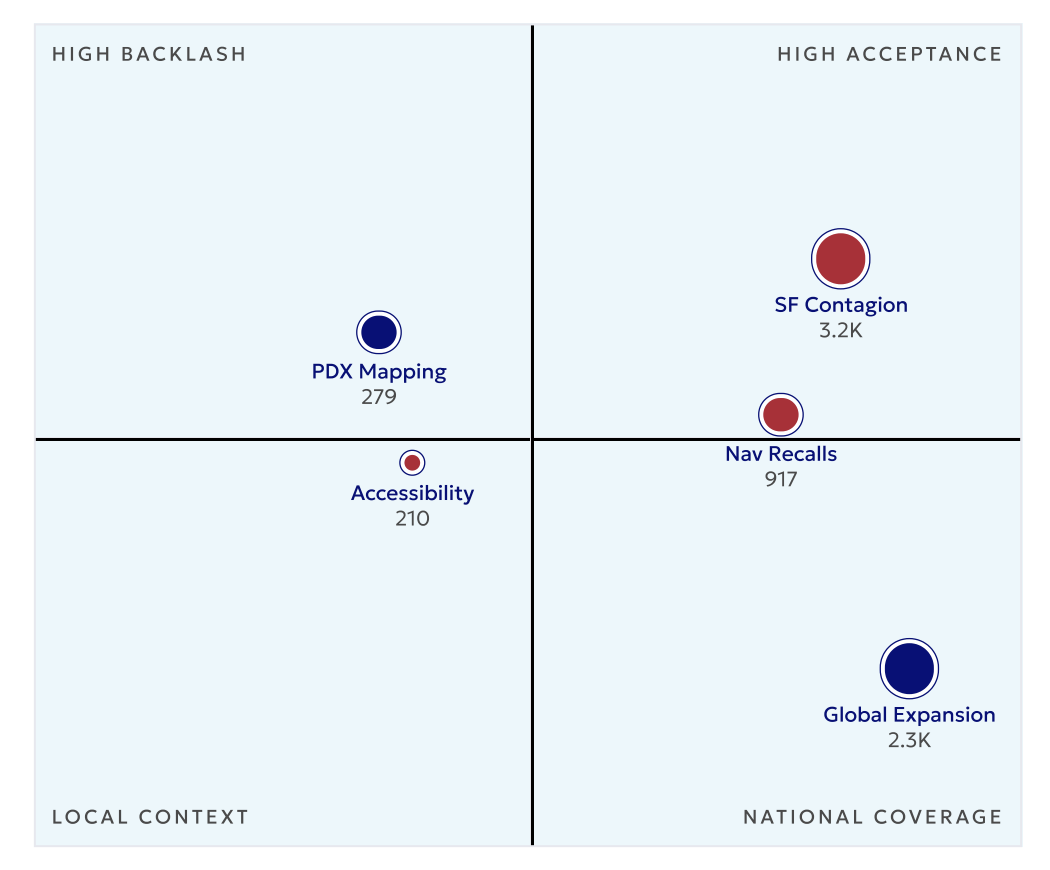
279 records show mapping vehicles on Portland streets are generating real-time chatter and alarm weeks or months before any formal deployment. The visual sight of sensors on unfamiliar streets is doing narrative work Waymo hasn't authorized.San Francisco's backlash is being transmitted, not just reported.
3.2K records document viral videos of SF interference incidents being actively reposted by Portland accounts, framing resistance as a trend rather than isolated vandalism. This is digital contagion, not organic local skepticism.A single navigation recall did more damage than any single incident. 917 records tie directly to Waymo's construction-zone navigation recall — a technical failure that undercuts the company's core "safer than human drivers" claim in a city famous for construction and rain.
Wheelchair exclusion is a civil-rights fight waiting to happen.
210 records show Portland's disability advocacy networks already organizing specifically around non-transferable power wheelchair exclusions — a small volume with outsized organizing capacity behind it.The "illusion of autonomy" story is now public record.
127 records from New Jersey legislative hearings revealed Waymo relies on remote human operators in the Philippines — ammunition for a labor-outsourcing narrative that hasn't yet hit Portland but will.

WHAT A STANDARD TOOL WOULD HAVE MISSED
A keyword search for "Waymo" would return general tech coverage indistinguishable from Uber or Tesla news, plus a flood of job postings and stock chatter. Discover's query isolated Portland-specific mapping conversation from the national San Francisco narrative as two separate clusters that could then be measured against each other. A standard tool would have reported one blended sentiment score. Discover showed the transmission mechanism directly: SF backlash content reposted by Portland accounts, turning a distant controversy into local, physical anxiety before a single ride has happened.
Three choices — not ten instructions
A. Get ahead of the narrative vacuum now, not at launch. 279 records show mapping vehicles are already being filled with backlash stories by local skeptics. A proactive community trust initiative — direct dialogue with community leaders, transparent safety verification — needs to happen before, not after, the first passenger trial.
B. Solve for wheelchair access before advocates force the issue. 210 records show a small but highly organized network already building the case. Committing to a defined percentage of wheelchair-accessible vehicles in the initial fleet turns a civil-rights liability into a public alliance.
C. Get in front of the remote-operator story before New Jersey's hearings reach Oregon. 127 records show the "illusion of autonomy" narrative is public and spreading. Reframe remote assistance proactively as a safety feature with domestic oversight — waiting for a journalist to ask first guarantees the worst framing wins.
ABOUT THIS REPORT
This report was produced using Tellagence Discover, a contextual intelligence platform. Contextual intelligence is the discipline of surfacing specific, sized, and human insights from large volumes of unstructured data — going beyond the obvious AI summary to find what the data actually means, not just what it says. Discover analyzed 11,900 records across social, news, and blog platforms using a custom semantic clustering engine, achieving a 95% confidence score. All reports are produced by the Tellagence research team.
Want to see Discover run a pulse on your brand's audience? Let's talk.