The Real Cannes Lions Crisis Isn't Influencers. It's the Price Tag.
Tellagence Discover analyzed 8,400 industry conversations about Cannes Lions across two festival cycles. The headline finding: the "creator takeover" everyone's arguing about is actually the festival's most positive storyline — the real threat is a quiet, concentrated cost-and-access backlash nobody's tweeting about at volume.
Everyone in advertising has an opinion about whether Cannes Lions is losing its soul to influencers. The data says: not really.
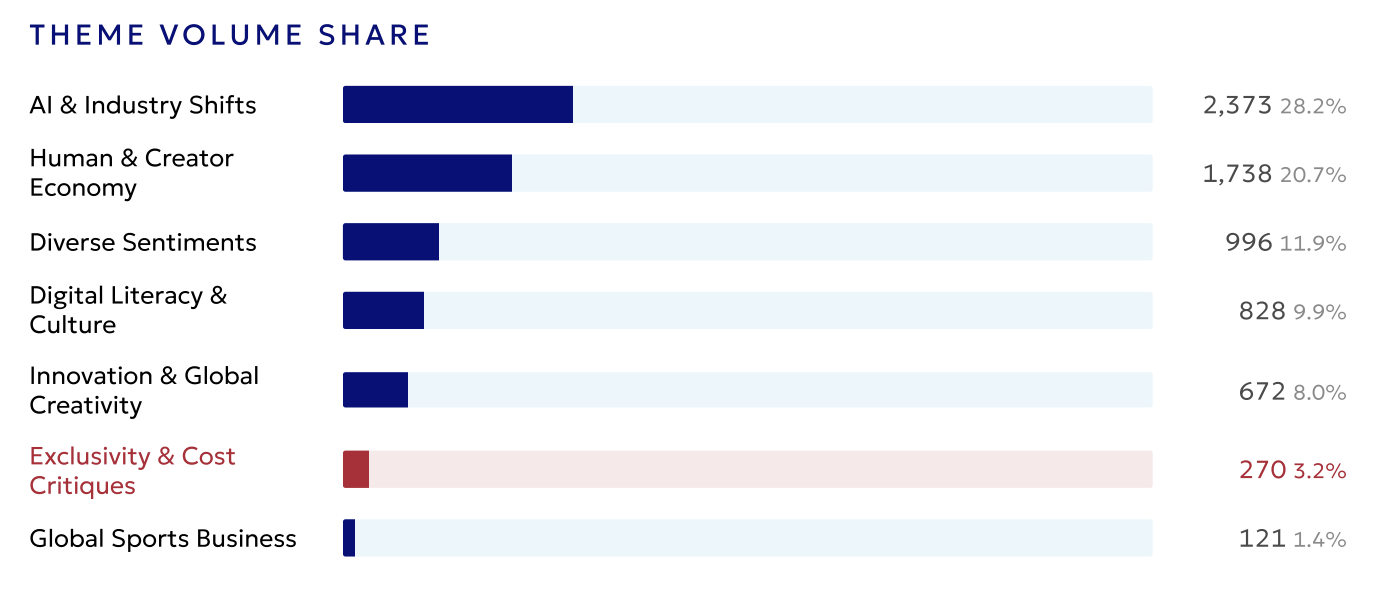
AI & Industry Shifts and Human & Creator Economy are the two largest conversation themes in the corpus — 2,373 and 1,738 records — and both sit in the high-engagement, high-sentiment quadrant of our map. The over-influencification debate is real, but it's a healthy argument happening inside a thriving conversation, not a sign of decline.
The actual danger zone is smaller and angrier. Exclusivity & Cost Critiques account for just 270 records — 3.2% of total volume — but it's the most concentrated cluster of negative sentiment in the entire dataset, and it sits alone in the low-engagement, low-sentiment quadrant with nobody defending it.
What the data actually showed
AI has stopped being a talking point and become plumbing. 2,373 records (28.2% of the corpus) discuss AI as embedded workflow infrastructure — real-time personalization, automated media planning — not a novelty act. Brands still pitching "we used AI!" as a headline are a year behind the room.
The "Human Premium" is now a jury requirement, not a nice-to-have. 1,738 records show juries and audiences explicitly rewarding work with deep human insight over polished AI output, with 224 records specifically flagging "AI slop" fatigue. The brief for any Cannes-bound campaign now needs a named human fingerprint, not just a tech stack.
Independent agencies are quietly opting out. 270 records of exclusivity criticism concentrate around high entry costs and diminishing ROI for smaller players — small in volume, but it's the only cluster in the corpus with zero positive counterweight. That's a structural problem, not noise.
Grassroots purpose work is outperforming corporate virtue statements. 141 records tied to campaigns like India's "Mothers of Courage" project generate outsized positive engagement, while abstract purpose messaging draws swift, visible backlash.
Sports and athlete-led commerce are the sleeper growth story. 121 records on SPORT BEACH and athlete co-creation signal a shift from athletes-as-endorsers to athletes-as-creative-partners — still small, but growing from a standing start.

WHAT A STANDARD TOOL WOULD HAVE MISSED
A keyword search for "Cannes Lions" would have returned a wall of tourism content, film festival confusion, and job postings — noise that swamps any real signal.
Discover's query isolated professional advertising discourse specifically, then split "AI as hype" from "AI as infrastructure" as two distinct conversational moments 18 months apart.
A standard tool would have flattened the exclusivity complaints into general festival grumbling. Discover isolated it as its own cluster — small, angry, and completely unanswered by anyone defending the status quo.
Three choices — not ten instructions
A. Fund the workspace, not the yacht party. The exclusivity cluster is small but undefended — brands that host open-access, utility-focused fringe activations (reliable wifi, functional meeting space) can capture the goodwill of an entire underserved segment for the cost of one influencer beach day.
B. Put a name on the AI. 224 records show consumers and juries actively rejecting anonymous AI output. Every campaign entering Cannes-adjacent conversation needs a credited human strategist attached to the work, not just a tools list.
C. Vet purpose campaigns like you'd vet a legal claim. 185 records show culturally tone-deaf purpose activations get called out fast and publicly. Grassroots, verifiable action beats a statement every time — check the receipts before you launch.
ABOUT THIS REPORT
This report was produced using Tellagence Discover, a contextual intelligence platform. Contextual intelligence is the discipline of surfacing specific, sized, and human insights from large volumes of unstructured data — going beyond the obvious AI summary to find what the data actually means, not just what it says. Discover analyzed 8,400 records across social, news, blog, and forum platforms using a custom semantic clustering engine, achieving a 95% confidence score. All reports are produced by the Tellagence research team.
Want to see Discover run a pulse on your brand's audience? Let's talk.