The Makeup Won, but Euphoria's Finale Divided Audiences.
A 10-month analysis of 112,600 records on Euphoria female representation finds that Gen Z audiences have separated the show's bold aesthetic from its toxic narrative — and beauty brands still treating them as one thing are building campaigns on the wrong signal.
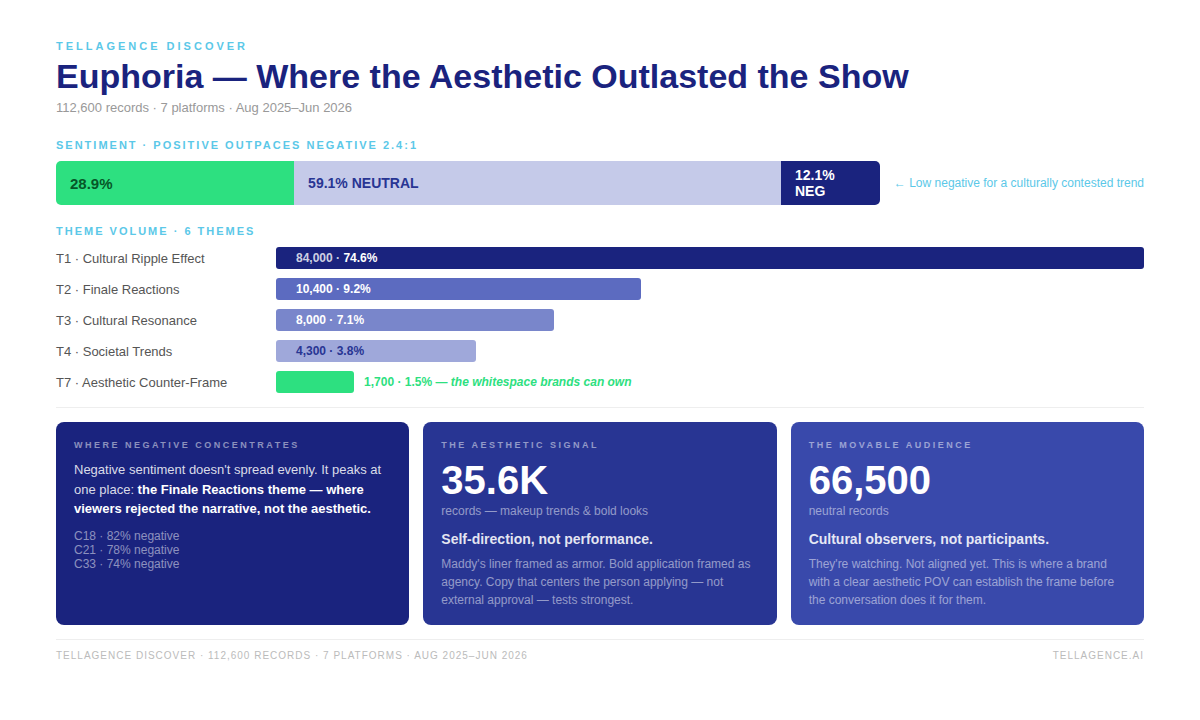
112.6K records analyzed · 28.9% positive sentiment · 94.8% confidence score · 74.6% cultural ripple effect
Gen Z women are recreating Maddy Perez's revenge eyeliner at a rate of 35,600 social posts. They are also, in a separate corner of the same world, calling the show's narrative a male-gaze-driven exploitation of female trauma. These two conversations coexist in the same dataset. That coexistence is the signal.
Tellagence Discover analyzed 112,600 verified records across TikTok, Instagram, X/Twitter, Threads, YouTube, blogs, forums, and news sources from August 2025 to June 2026. The corpus covers Euphoria's final season and its cultural fallout. At 94.8% confidence, the data resolves what headline sentiment alone obscures: this audience has split the aesthetic from the show. They kept the glitter. They rejected the gaze.
What the data actually showed
1. Bold makeup is the only piece of Euphoria that Gen Z claims as its own. Graphic eyeliner, rhinestones, and bold glitter drove 35,600 records — the largest conversation cluster in the entire corpus — with overwhelmingly positive sentiment. Users describe Maddy Perez's "revenge eyeliner" as armor. They frame the application process as an act of self-direction, not beautification. The aesthetic has outlasted the show's credibility with its core audience. It now operates as its own cultural object.
2. The backlash is narrow, concentrated, and exactly where most brand campaigns land. The 13,600 negative records in this corpus do not spread evenly. They cluster around character objectification, the male gaze critique, and what audiences describe as the romanticization of female trauma. Cassie Howard's styling and the show's addiction arcs sit at the lowest point of the engagement map — high friction, below-average volume, and intensely negative within those clusters. Campaigns built on the show's broader "chaotic glam" visual grammar place themselves squarely inside that zone.
3. The finale accelerated the split. The series finale generated 10,400 records and the second-highest concentration of negative sentiment in the dataset. Viewers rejected the storytelling choices — abrupt character deaths, unresolved plotlines, perceived exploitation of female trauma for aesthetic effect — without rejecting the visual vocabulary Gen Z built around the show's early seasons. That distinction matters to anyone still associating campaign assets with the broader property rather than the specific aesthetic language audiences have claimed.
4. Barbie Ferreira's exit has become a brand signal. Her public departure from the show — framed as a rejection of objectifying, one-dimensional representation — generated substantial organic positive discourse. Gen Z reads her choice as a demonstration of aesthetic integrity. Brands that use body-diverse casting as a performative checkbox register as its opposite.
What a standard tool would have missed — the Discover edge
A keyword-based sentiment scan of this corpus returns 28.9% positive, 59.1% neutral, 12.1% negative. The report would read as a healthy conversation with manageable negatives.
Two things sit below that headline figure that change the picture.
First, the negative records are not distributed. They cluster at specific conversation nodes — character objectification, trauma exploitation, Cassie Howard's styling — at densities that exceed 80% negative within those clusters. A tool that averages sentiment misses the location of the problem and, by extension, the specific creative choices that trigger it.
Second, the positive and negative conversations reference the same show but entirely different things. One group celebrates the makeup. The other group critiques the narrative. A brand drawing visual inspiration from "Euphoria" without distinguishing between those two targets will borrow from the wrong half without knowing it.
Tellagence Discover surfaces this through bottom-up semantic clustering. The corpus organized itself into 13 distinct themes before any predefined filter was applied. That self-organization is what reveals the split — and why the headline sentiment number obscures more than it explains.
Three choices for beauty and fashion brands
A. Separate the aesthetic from the show. The Euphoria look belongs to Gen Z now, not to the series. Build campaigns around graphic liner, rhinestones, and bold color as self-directed creative tools — without anchoring the visual story to the show's characters or narrative arcs. The aesthetic has outrun its origin. Campaigns that acknowledge this will feel current. Campaigns that treat it as IP-adjacent will feel dated.
B. Frame makeup application as agency, not transformation. The data shows users describe bold makeup as armor, play, and identity construction — not as a strategy for attracting approval. Copy that positions cosmetics as tools for correction, enhancement, or external validation reads as misaligned with what this audience actually does with the product. Show the process. Center the person holding the liner.
C. Audit your existing asset library before the next campaign launch. Two watchlist signals in this report carry an "Act Now" designation: Fentanyl/Addiction Backlash (growing social connections between the show's aesthetic and the real-world opioid crisis) and the Decline of the Baddie Aesthetic (Gen Z shifting toward fluid, comfortable styling over tight, revealing cuts). Campaigns in production that lean on either of those visual frameworks have a short window to course-correct.
These three choices connect. A brand that separates the aesthetic from the show (A), frames that aesthetic as self-directed (B), and audits its library for friction signals (C) holds a coherent position. Any one of them in isolation does partial work.
This report was produced using Tellagence Discover, a contextual intelligence platform. Contextual intelligence is the discipline of surfacing specific, sized human insights from large volumes of unstructured data — going beyond the obvious AI summary to find what the data actually means, not just what it says. Discover analyzed 112,600 records across social media, blogs, forums, and news from August 2025 to June 2026 using a custom semantic clustering engine, achieving a 94.8% confidence score. All reports are produced by the Tellagence research team.