

The Scientology Speed Run Trend Isn't About Religion. Here's What It's Actually About.
Tellagence Discover analyzed two months of the speed run phenomenon across 9 platforms. The headline sentiment read was 56% neutral — balanced. The data was not.
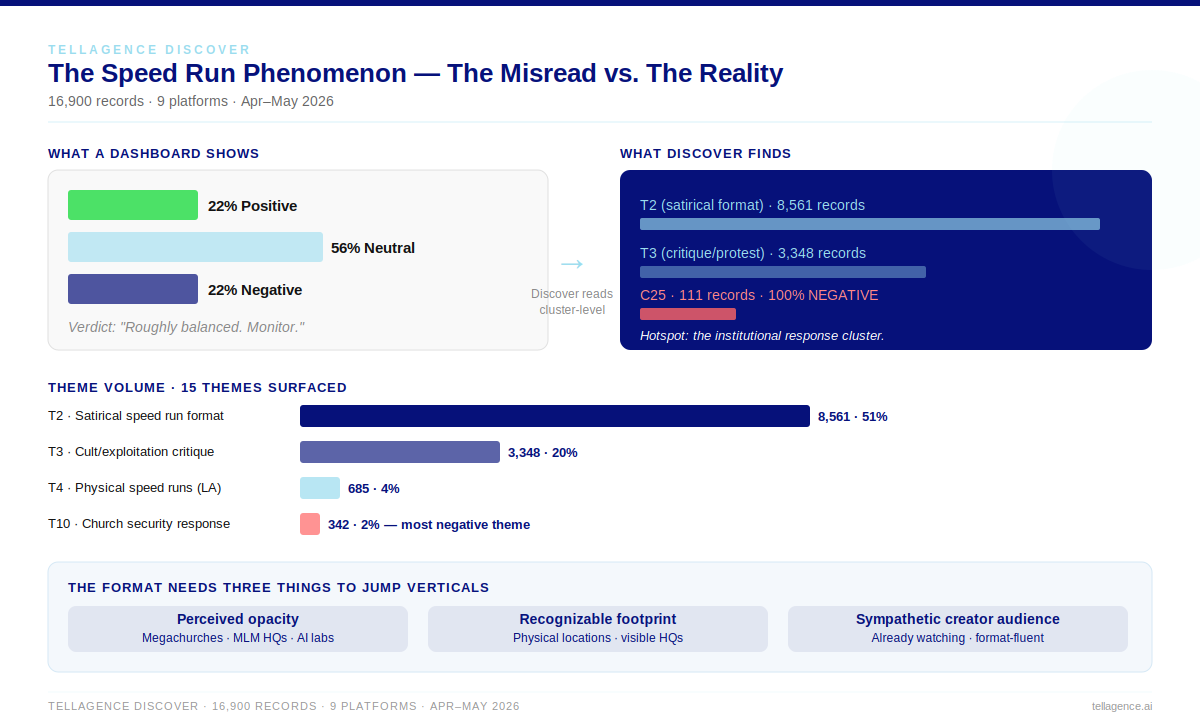
A standard sentiment dashboard reading this conversation would tell you it's roughly balanced — 22% positive, 22% negative, 56% neutral — and probably log it as something to monitor. That read is technically correct and practically useless.
We pulled 16,900 records across 9 platforms to actually look at what was happening. The trend isn't about Scientology doctrine. It isn't even really about Scientology. It's about the gamification of institutional opacity — and that format is portable to any organization that looks opaque, has a physical presence, and has a sympathetic creator audience. Which is more organizations than you'd think.
What the data actually showed
1. The 56% neutral majority is documentary-meme tone, not balanced sentiment. News coverage, reaction content, creator commentary describing the trend without taking a stance all register as neutral. When you read at cluster level, concentrated negative pockets appear that the headline flattens entirely: clusters at 83%, 88%, and 100% negative. The polarity score doesn't tell you where the heat actually is.
2. The Church's defensive response generated more concentrated negativity than the original meme. The single most-negative cluster in the dataset — 111 records at 100% negative — isn't about doctrine. It's about the institutional response: door handle removal, cease-and-desist letters, increased police presence. Every defensive move fed content back into the format. The Streisand effect is fully operational here.
3. Gaming language is doing the cultural work. Tom Cruise as final boss. Miscavige as mid-level antagonist. Members as NPCs. Buildings as multi-floor dungeons. This single linguistic frame converts what would otherwise read as harassment into celebrated creator content. 388 records cluster explicitly around the video-game-speedrun framing. That's the reason the format travels — it gives participants a genre, and genres have their own permission structures.
4. The format is already spreading. T2 and T3 hold 70% of volume, but T5 (Roblox and AI fictional versions), T13 (South Park), and a documented signature audio bed signal that the pattern is extending past its natural peak. The analysis pushes the long-tail to 2027. 'Speed run of [X]' is becoming cultural shorthand, and the X is interchangeable.
THE DISCOVER EDGE
A sentiment dashboard reports 22/22/56 and files this as 'monitor.' We found a cluster at 100% negative anchored entirely to the institutional response, not the original meme. The strategic implication is completely different depending on which read you have. If you think sentiment is mixed, you do nothing. If you know the defense is generating more concentrated negativity than the attack, your entire response calculus changes. That's the gap contextual intelligence was built for.
Three choices worth considering
A. Weight sentiment by context, not just polarity. 22% positive in this corpus means humor receipts — likes and laughing emojis that read as meme participation, not brand approval. A dashboard that codes those as favorable is making a category error. Knowing what the positive sentiment is actually about changes every decision downstream.
B. For any institution in this format's crosshairs: don't feed it. The data is clear — defense reads as confirmation. Cease-and-desists to teen creators read as proof the satire landed. The asymmetric move is silence on the format and substance on legitimate critique through earned media. Starving the format is the only response that doesn't accelerate it.
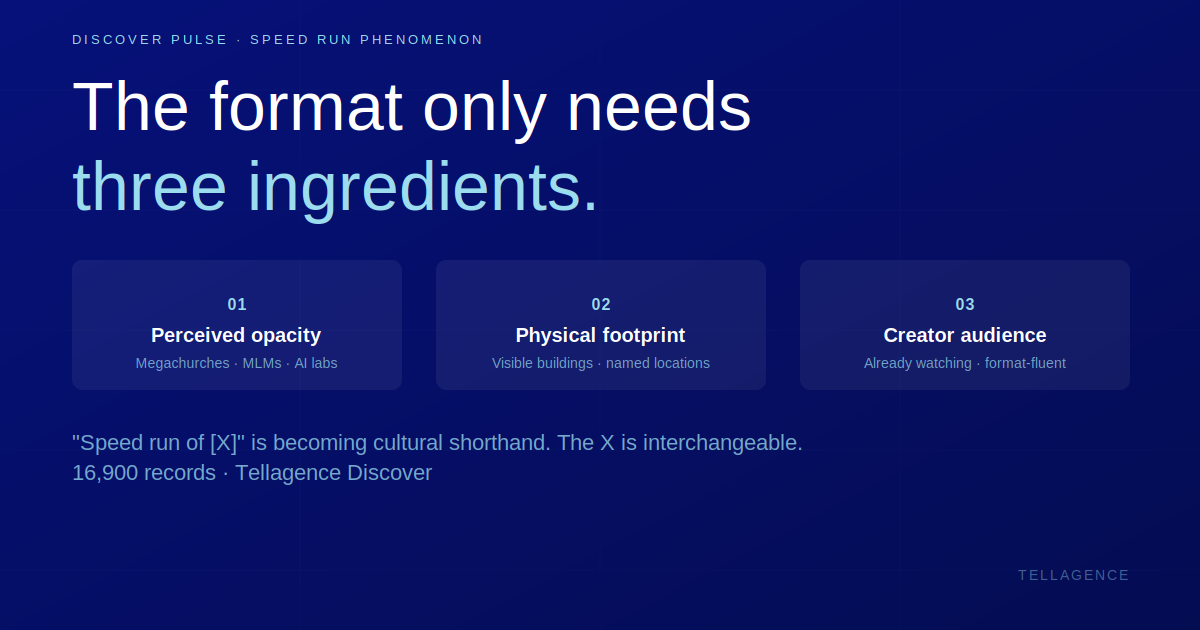
C. Build the watch list before the next subject appears. The format needs three things: perceived opacity, a recognizable physical presence, and a sympathetic creator audience. Megachurches, MLM headquarters, crypto exchanges, AI labs — they all qualify. Standing monitoring finds format jumps before they peak. Reactive analysis arrives after the permission slip has already been issued.
This report was produced using Tellagence Discover, a contextual intelligence platform. Contextual intelligence is the discipline of surfacing specific, sized human insights from large volumes of unstructured data — going beyond the obvious AI summary to find what the data actually means, not just what it says. Discover analyzed 16,900 records across 9 platforms using a custom semantic clustering engine, achieving a 92% confidence score. All reports are produced by the Tellagence research team.
Want Discover to run a pulse on your brand's audience? We surface what other tools miss. Let's talk. Get in touch.
