

Looksmaxxing Looks Like a Self-Improvement Trend. The Data Shows Something Else.
Tellagence Discover analyzed six months of looksmaxxing conversation across 7 platforms. The finding: a mental health crisis wearing the aesthetic of self-optimization.
Looksmaxxing presents itself as self-improvement. At the moderate end — skincare routines, posture work, fitness habits — it largely is. But Tellagence Discover analyzed 32,500 records across 7 platforms over six months, and what the data shows at the core of this conversation is something different: young men describing eating disorders, diminished self-worth, hopelessness, and desperation in their own words. Not as outside critics. As participants.
This analysis seeks to understand the actual shape of the conversation — who is in it, where the harm concentrates, and where the strategic white space sits for a clinical authority to intervene. What the data revealed is that the counter-narrative already exists. The audience built it. It's waiting for clinical grounding.
What the data actually showed
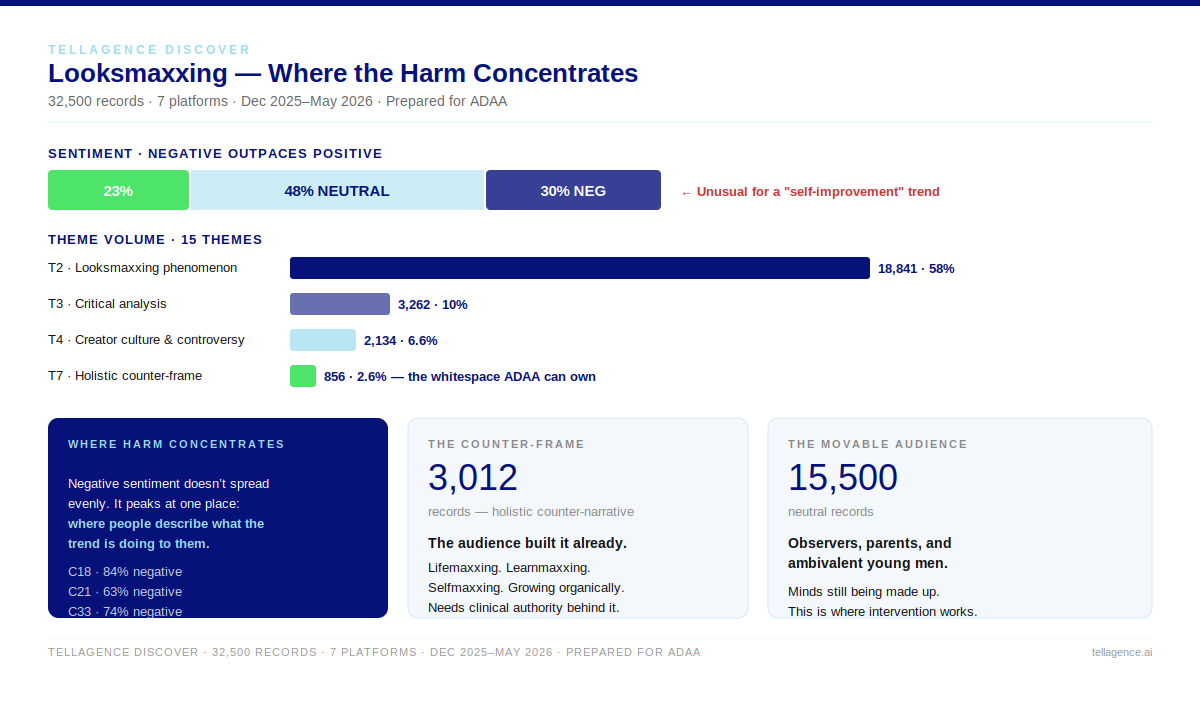
1. Negative sentiment outpaces positive — and it concentrates where lived experience appears. Negative sentiment (30%) runs ahead of positive (23%), which is unusual for a trend that markets itself as self-improvement. More importantly, it isn't diffuse. Clusters at 84%, 74%, and 63% negative all live at the same coordinates: where participants stop describing the trend and start describing what it's doing to them. Eating disorders. Self-worth collapse. Hopelessness.
2. The radicalization runs through aesthetics, not ideology. The data consistently links looksmaxxing to misogyny, blackpill ideology, and incel-adjacent worldviews. This aesthetic optimization gradually reframes appearance as destiny, intertwining the two. Interventions that speak to young men as 'victims of a beauty trend' will fail.
3. One streamer concentrates the entire category's reputational and safety risk. Across multiple themes and clusters, documented hospitalization, alleged misconduct, on-stream drug use, and platform bans all anchor to a single creator in the looksmaxxing-adjacent livestream ecosystem — reportedly earning significant income monthly while modeling the exact behaviors a clinical organization exists to prevent. For any brand, media buyer, or partner active in this space, this creator and the adjacent constellation are documented partnership risks.
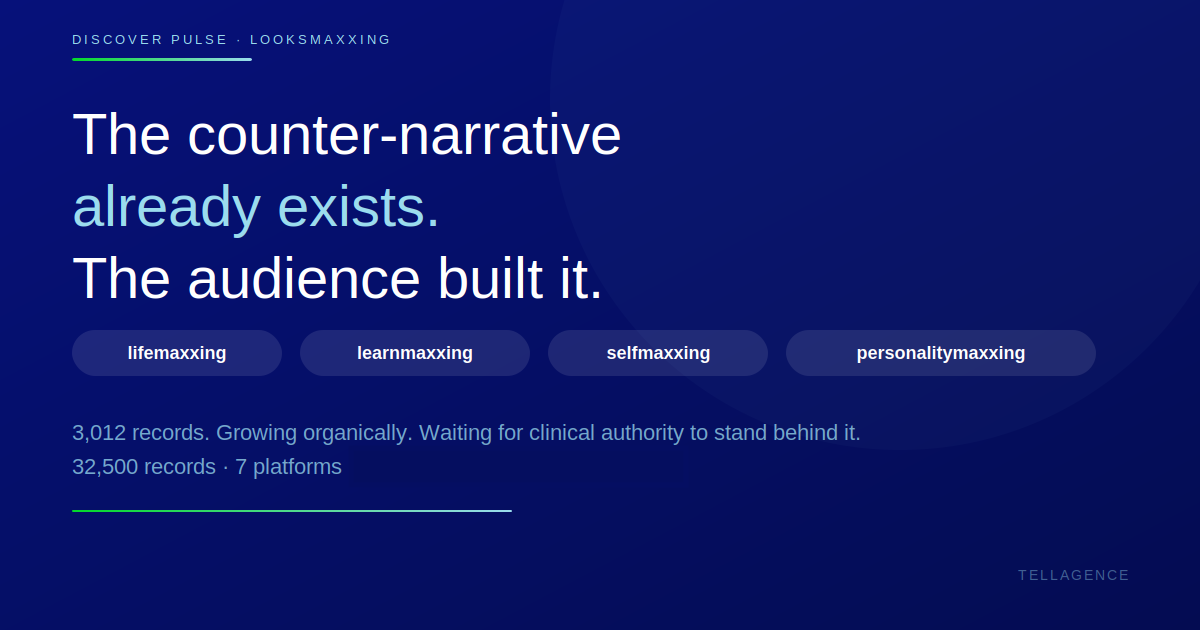
4. A counter-narrative already exists in the audience's own vocabulary. 3,012 records cluster around holistic self-improvement framing. Native terms — lifemaxxing, learnmaxxing, selfmaxxing, personalitymaxxing — are already in organic circulation as rebuttals to looksmaxxing. 856 records explicitly advocate internal wellness over superficial optimization. The counter-frame doesn't need to be invented. It needs clinical authority to validate it and trusted voices to amplify it.
WHAT A STANDARD TOOL WOULD HAVE MISSED
The query design is where this analysis lives or dies. A standard search for 'looksmaxxing' would have returned gym-culture content, beauty-adjacent discussions, gaming stat-maxing, and financial optimization.
Discover's Boolean isolation targeted the male aesthetic-optimization conversation specifically, producing a clean 32,500-record read.
Second: standard listening would have reported 48% neutral as 'low engagement' or 'no strong opinion.' Discover reads the 48% neutral majority as the strategic target — 15,500 observers, parents, and ambivalent young men whose minds are still being made up. That's where intervention works.
Three choices — not nine instructions
A. Translate into clinical vocabulary — use looksmaxxing only as a discovery hook. The diagnostic language is already in the public corpus: body dysmorphia, BDD, eating disorders, anxiety. Leading with clinical framing and using looksmaxxing terminology only for search discovery positions ADAA on its actual competitive advantage rather than entering a category fight against commercial wellness brands.
B. Build for the 48% neutral majority, not the converted edges. The movable audience is the 15,500 neutral records — observers, parents, and ambivalent participants who haven't committed. Content that gives them a framework, a vocabulary, and a clear next action reaches the population where the shift actually happens. Debating true believers moves the needle on audiences whose minds are already made up.
C. Validate the organic counter-frame rather than inventing a new one. A campaign positioned as 'the science behind selfmaxxing' or 'what learnmaxxing gets right' inherits the audience's existing momentum and meets them in their own language. A new ADAA-coined vocabulary competes against a growing organic counter-narrative the audience is already fluent in. The window where clinical authority can define this territory is measured in months, not years — commercial wellness brands will move to claim it without clinical grounding.
A is the positioning precondition. B identifies the audience. C is the vocabulary that connects them.
This report was produced using Tellagence Discover, a contextual intelligence platform. Contextual intelligence is the discipline of surfacing specific, sized, human insights from large volumes of unstructured data — going beyond the obvious AI summary to find what the data actually means, not just what it says. Discover analyzed 32,500 records across 7 platforms using a custom semantic clustering engine and a Gen Z slang dictionary, achieving a 91% confidence score. All reports are produced by the Tellagence research team.
If you or someone you know is struggling with body image, eating disorders, or mental health, the ADAA provides resources and support at adaa.org. The National Alliance for Eating Disorders helpline is available at 1-866-662-1235.
