

2026 is the new 2016. What 152,700 Records Say About the Trend.
Tellagence Discover analyzed 12 months of '2016 is the new 2016' conversation across 11 platforms. The headline finding: this isn't throwback content. It's active re-adoption driven by algorithm burnout — and it's producing real purchase intent.
Something worth paying attention to is happening in fashion and beauty. Chokers are back, Adidas Superstars are generating their own purchase clusters, and matte lip kits are seeing active buying conversation dated to 2026. This isn't 'I miss 2016' content. These are people acquiring things, right now, for current use.
We analyzed 152,700 records across 11 platforms to understand what's actually driving the '2026 is the new 2016' moment. The surface answer is King Kylie and TikTok aesthetics. The structural answer is more interesting — and more useful to anyone trying to figure out what to do about it.
What the data actually showed
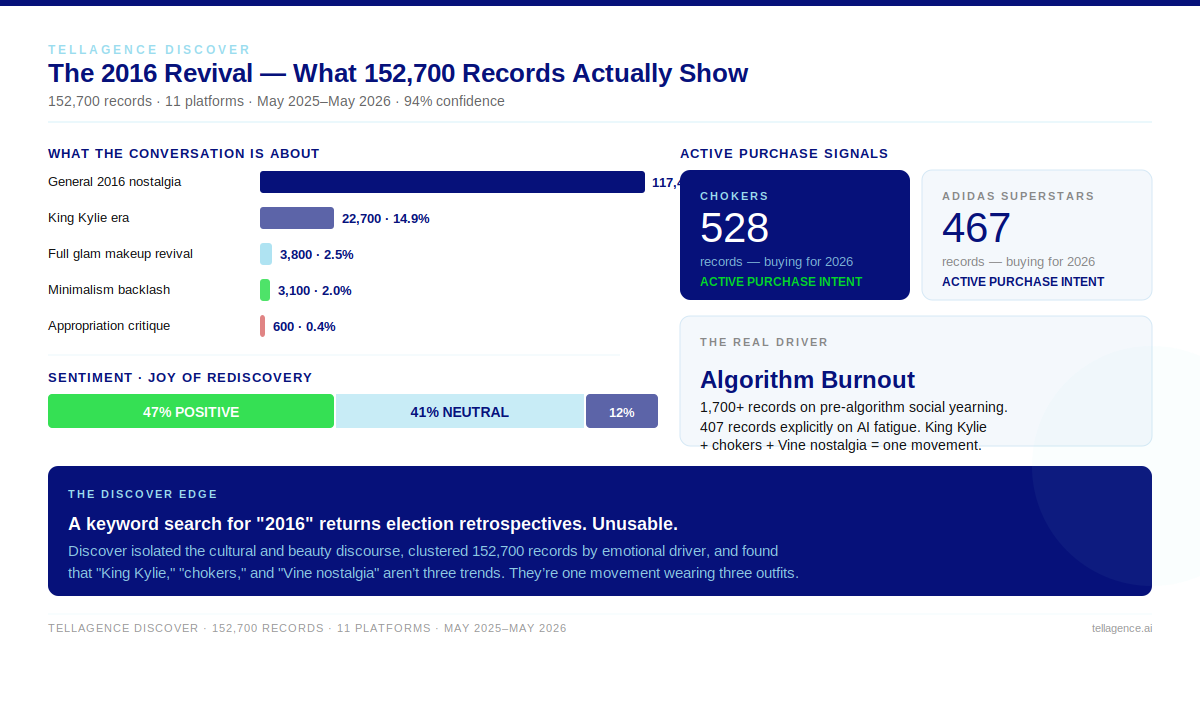
1. This is active re-adoption, not passive reminiscing. Users are buying chokers and Adidas Superstars for 2026 use — the clusters document purchase intent, not nostalgia content. 528 records on chokers and 467 on Adidas Superstars are explicitly about current acquisition, not memory. Retailers should plan inventory accordingly.
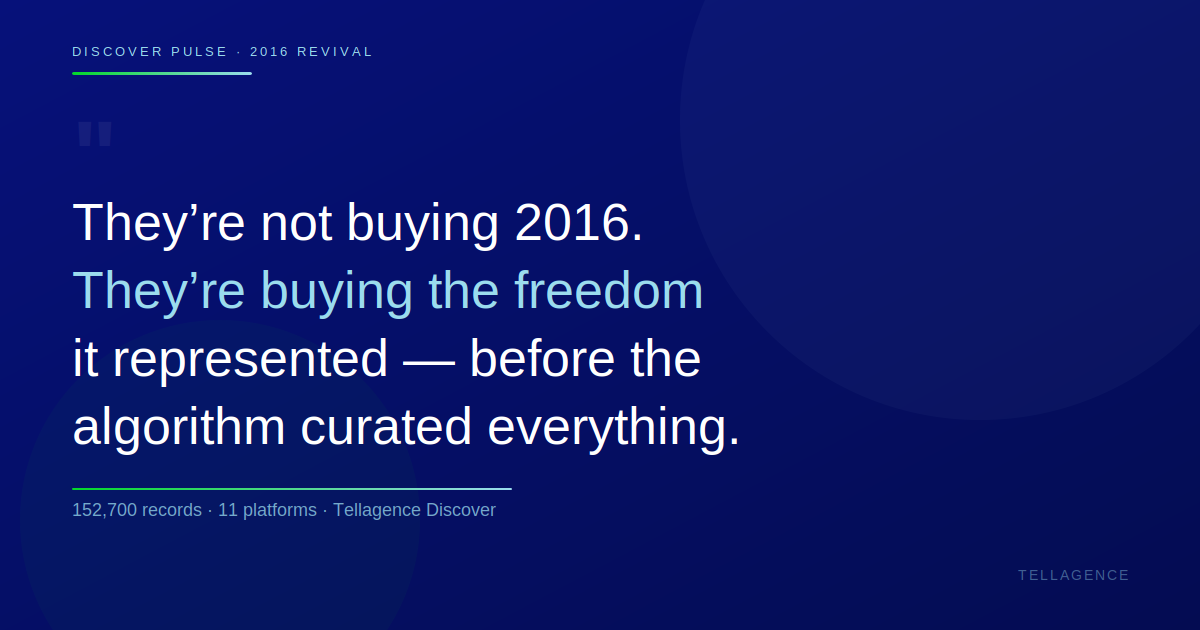
2. King Kylie is the commercial engine, but burnout is the real driver. 22,700 records cluster around Kylie Jenner's persona revival — the highest-advocacy commercial thread in the dataset. But Discover clusters 'King Kylie' content alongside the underlying emotional driver: 1,700 records on the yearning for pre-algorithm social, and 407 on AI fatigue specifically. The audience isn't buying a look. They're buying a feeling of freedom from curation.
3. 'Clean Girl' is being explicitly rejected. 3,100 records name minimalism backlash directly. The framing is overt in the corpus: Clean Girl reads as maintenance; Full Glam reads as freedom. This is a positioning opportunity — and the first brand to claim 'Be Loud / Be Extra' as a contrasting stance gets the cultural energy before a competitor does.
4. The appropriation question is small in volume but structurally connected. 553 and 632 records respectively form a pointed appropriation critique linked directly to the King Kylie commercial engine. Small in absolute volume, but uniform in stance. Any activation routing through the Jenner revival without acknowledging the cultural origins of the aesthetic runs directly into this thread.
WHAT A STANDARD TOOL WOULD HAVE MISSED
A keyword search for '2016' would have been swamped by election retrospectives — completely unusable data. Discover's query isolated the cultural, fashion, and beauty discourse, filtering political noise before a single record was analyzed. Second: standard listening would have reported 'King Kylie' and 'chokers' and 'Vine' as separate trend stories. Discover clustered them by the underlying emotional driver — algorithm and AI fatigue — revealing that these aren't three trends. They're one movement with three expressions.
Three choices — not ten instructions
A. Reinterpret, don't replicate. The audience wants the 2016 silhouette, not the 2016 supply chain. Bodycon, chokers, distressed denim — same shapes, 2026 materials and inclusive sizing. Brands that do pure replica will face immediate criticism on exactly the dimensions the original era was already criticized for.
B. Lower production values, not brand standards. 1,700 records document the audience's desire for casual, unpolished, low-stakes posting in the spirit of early Snapchat and Vine. High-production 'perfect' content is being read as the thing the trend is explicitly rejecting. The permission to look unfinished is the brief.
C. Move before fast fashion commodifies the aesthetic. The exit signal for this trend will be mass-market saturation — when every H&M has a bodycon display and the choker is in the airport gift shop. The data shows that moment hasn't arrived yet. The archive drop, the 'Be Extra' positioning, the Tumblr-style community — all of these have a window. It's measured in months, not years.
B is the content prerequisite. Without it, A and C feel like corporate cosplay.
ABOUT THIS REPORT
This report was produced using Tellagence Discover, a contextual intelligence platform. Contextual intelligence is the discipline of surfacing specific, sized, and human insights from large volumes of unstructured data — going beyond the obvious AI summary to find what the data actually means, not just what it says. Discover analyzed 48,500 records across 11 platforms using a custom semantic clustering engine and a Gen Z slang dictionary, achieving a 94% confidence score. All reports are produced by the Tellagence research team.
