

A 15-Second TikTok Jingle Hit 27 Million Views. Here's What 77,100 People Said About It.
Tellagence Discover analyzed two months of the Dr Pepper 'Good and Nice' viral moment across 9 platforms. The positive sentiment was real. The compensation debate was the risk nobody saw coming.
In December 2025, a 15-second TikTok appeared. Creator @romeosshow filmed herself singing a simple jingle — 'Dr Pepper, baby. It's good and nice. Doo doo doo.' Within days, it had 27 million views and 3 million likes. No media budget. No seeding strategy. No brief. Just a voice, a can, and a melody the internet decided it couldn't get out of its head.
Dr Pepper responded within 24 hours of the brand tag, licensed the audio, and placed a national spot during the College Football Playoff National Championship within weeks. By most measures, a textbook reactive marketing win. But when Tellagence Discover analyzed 77,100 records about the moment, we found two stories running in parallel — and one of them had nothing to do with the jingle.
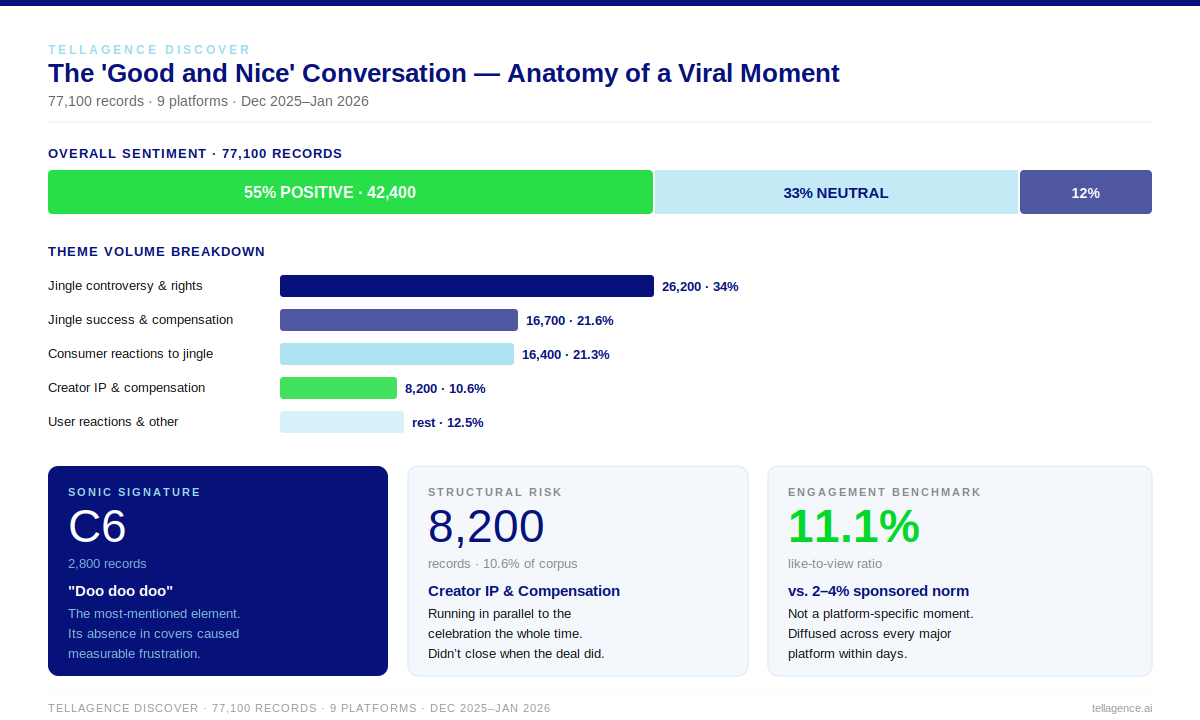
What the data actually showed
1. The organic reach was genuinely historic. A like-to-view ratio of 11.1% puts this 3–5 times above typical sponsored content benchmarks. More importantly, the sentiment diffused across every major platform within days — TikTok as origin surface, then Instagram, Reddit, YouTube, X, Facebook, and news coverage. This wasn't platform-specific virality. It was cultural penetration.
2. The phrase 'good and nice' became purchase intent. 13,700 records clustered specifically around the phrase and melody — not just discussing it, but expressing brand desire and craving in the same breath. The sales effect and the cultural effect were appearing in the same conversations. That coupling is rare and commercially significant.
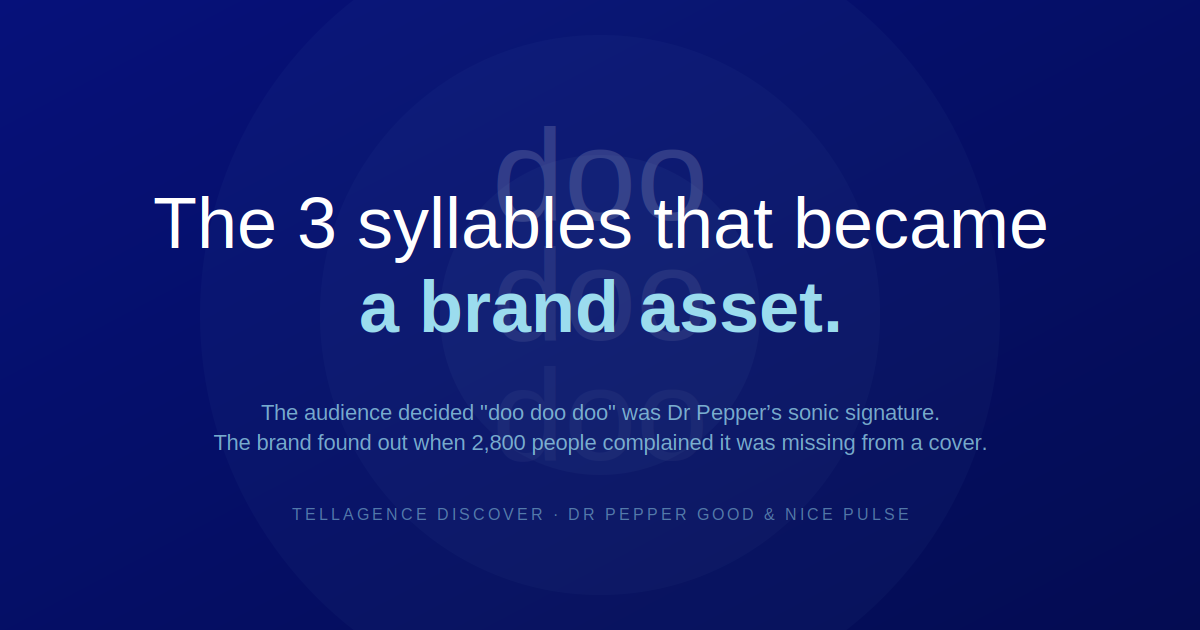
3. 'Doo doo doo' is the actual brand asset. Standard tools would have counted mentions of 'Dr Pepper' and the creator's name. Discover surfaced that the specific three-syllable vocalization — 'doo doo doo' — was the single most-mentioned element of the jingle. Its absence in covers, remixes, and competing versions caused measurable frustration. The audience had already decided this was the brand's sonic signature. They did it before the brand did.
4. The compensation debate was the structural risk — and it ran alongside the celebration. 8,200 records formed their own theme on creator IP and compensation, entirely separate from the jingle enthusiasm. Accusations of IP theft, exploitation framing, and demands to 'pay the creator' appeared fast. A deleted comment from the official Dr Pepper account became its own micro-story. Even after the deal closed, the 'adequate compensation' debate continued in creator-economy circles.
WHAT A STANDARD TOOL WOULD HAVE MISSED
A keyword scan would have returned high volume and strong positive sentiment — and stopped there. Discover's bottom-up segmentation separated 'Creator IP & Compensation' (8,200 records) as its own structural theme before any human touched the data. That's the thread the brand needed to manage. It's also invisible to mention-counting tools. The 'doo doo doo' finding is the same story: no keyword search would have surfaced a three-syllable vocalization as the primary brand identifier. Discover found it because the clusters surfaced what the audience was actually saying, not what the query was looking for.
Three choices — not nine instructions
A. Make 'doo doo doo' a mandatory sonic brand element, not an optional flourish. The audience already coded it as Dr Pepper. Treating it as remix-able or replaceable means voluntarily giving up the asset they handed the brand for free.
B. Build the rapid-response playbook before the next viral moment, not during it. The 24-hour response that worked here is now the floor the audience expects. The structural opportunity is a standing unit with pre-cleared creator rights templates so legal isn't the rate-limiter when the next window opens.
C. Manage compensation sentiment with transparency, not silence. The licensing deal didn't close the conversation — it paused it. Publicly articulating creator compensation principles (structure and philosophy, not necessarily dollar figures) is higher-leverage than the headline number. The audience watches for follow-through.
These three choices compose: B is the precondition that makes A and C possible at speed.
This report was produced using Tellagence Discover, a contextual intelligence platform. Contextual intelligence is the discipline of surfacing specific, sized, human insights from large volumes of unstructured data — going beyond the obvious AI summary to find what the data actually means, not just what it says. Discover analyzed 77,100 records across 9 platforms using a custom semantic clustering engine and a Gen Z slang dictionary, achieving a 94% confidence score. All reports are produced by the Tellagence research team.
