

Busch Light Apple Isn’t a Beer Anymore. Here’s What 48,500 People Say It Is.
Tellagence Discover analyzed 12 months of Busch Light Apple conversation across 11 platforms. What we found has nothing to do with beer.
Every spring, something strange happens on TikTok. Thousands of people start filming themselves driving to gas stations, liquor stores, and convenience stores across state lines — not to find a concert ticket or a rare sneaker, but to find a can of beer. A specific beer. A seasonal, apple-flavored beer from Busch that they have collectively renamed “Bapple.”
If you think that’s a niche subculture, consider this: over the twelve months from May 2025 to May 2026, Tellagence Discover analyzed 48,500 distinct records about Busch Light Apple across 11 social platforms. What we found wasn’t a beer brand with a loyal fanbase. It was a cult with a lifestyle, a lexicon, and a seasonal calendar — and the can of beer was almost incidental to all of it.
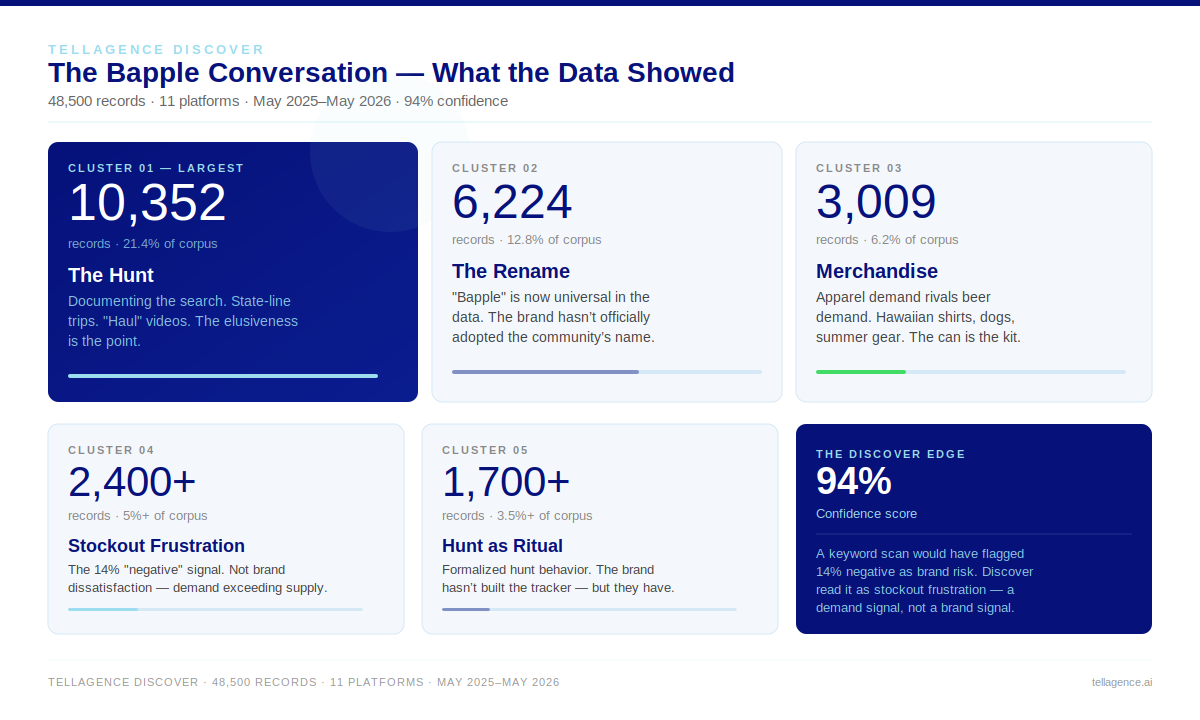
What the data actually showed
1. The hunt became the product.
The single largest cluster in the entire dataset wasn’t about flavor. It wasn’t about price. It was about the search. 10,352 records — more than 21% of the entire corpus — documented the experience of trying to find Bapple. People are traveling across state lines. They’re posting “haul” videos when they succeed. The elusiveness of the product isn’t a supply chain failure. For this audience, it’s the whole point.
2. The audience renamed the brand — and the brand hasn’t caught up yet.
The transition from “Busch Light Apple” to “Bapple” is nearly universal in the data. This isn’t casual shorthand. When an audience renames your product, they’ve adopted it. They’ve moved it from corporate property to community property. The data also shows “Bapple Sauce” as a viral meme format — people replacing “Apple” with “Bapple” in everyday phrases on TikTok — pulling non-drinkers into the brand conversation entirely. 6,224 records were classified in the meme and slang cluster. The brand has not officially adopted the community’s own name for it.
3. Merchandise demand rivals beer demand.
3,009 records documented demand for Bapple-branded merchandise — Hawaiian shirts, summer gear, dog accessories. These aren’t people asking for free swag. They’re documenting a “summer uniform” and looking for ways to wear the lifestyle year-round. This cluster outweighed the flavor discussion cluster entirely. The can of beer is a piece of the kit. It is not the kit.
4. The negative sentiment is actually a signal of demand, not dissatisfaction.
14% of the corpus was negative. A standard sentiment tool would flag this and recommend brand intervention. But the data tells a completely different story: the negative sentiment is almost entirely concentrated in stockout frustration. People are angry they can’t get more, not angry at what they got. The structural difference matters enormously. The brand’s emotional ledger is positive. The supply chain’s ledger is negative. Those require very different responses.
What a standard tool would have missed
A category-keyword scan for “Busch Light Apple” would have returned beer chatter, some positive reviews, and a scattering of seasonal mentions. It would not have found the Bapple Hunt, nor sized the merch cluster against the flavor cluster. It would not have caught that “Goated” and “Bapple Sauce” are positive advocacy signals in this community — a standard sentiment dictionary would have misclassified them as noise.
Discover uses a custom Gen Z slang dictionary and semantic clustering to find what the data actually means, not just what it says.
Three choices — not nine instructions
Based on 12 months of data, there are three distinct strategic moves available to this brand. Not a 40-page playbook. Three choices.
A. Sell the summer kit, not the can.
Merchandise demand (3,009 records) rivals beer demand. The “summer uniform” — Hawaiian shirts, dogs, casual country aesthetic — is already a brand identity that the audience is building without the brand’s help. A DTC apparel line or a lifestyle partnership campaign treats the aesthetic as the primary product surface. The can follows the kit, not the other way around.
B. Make the hunt official.
The Bapple Hunt is already a social ritual. 1,700+ records document it. There is rising frustration (2,400+ records) as the hunt gets harder. The brand could formalize what already exists: a digital stock tracker, limited-drop alerts, a “hunt journal” format. The tool already exists in the audience’s imagination. The brand just hasn’t built it yet.
C. Own the shoulder season.
Data density peaks April through June — the window between traditional beer-buying winter and the core summer seltzer surge. No competitor has claimed this period. Anchoring the launch to April and branding the window as the “Bapple Window” is a calendar move as much as a marketing move. Beat the seltzers to the season.
These three choices are synergistic, not competing. The summer kit creates the surface. The hunt tracker converts frustration into ritual. The shoulder season makes both stick year over year.
ABOUT THIS REPORT
This report was produced using Tellagence Discover, a contextual intelligence platform. Contextual intelligence is the discipline of surfacing specific, sized, and human insights from large volumes of unstructured data — going beyond the obvious AI summary to find what the data actually means, not just what it says. Discover analyzed 48,500 records across 11 platforms using a custom semantic clustering engine and a Gen Z slang dictionary, achieving a 94% confidence score. All reports are produced by the Tellagence research team.
