The Reverse POV the World Cup Is Missing
Tellagence Discover analyzed 31,100 fan conversations across six platforms during the 2026 FIFA World Cup, tracking cross-cultural dynamics in 16 North American host cities. The headline finding: the content everyone's watching isn't being made.
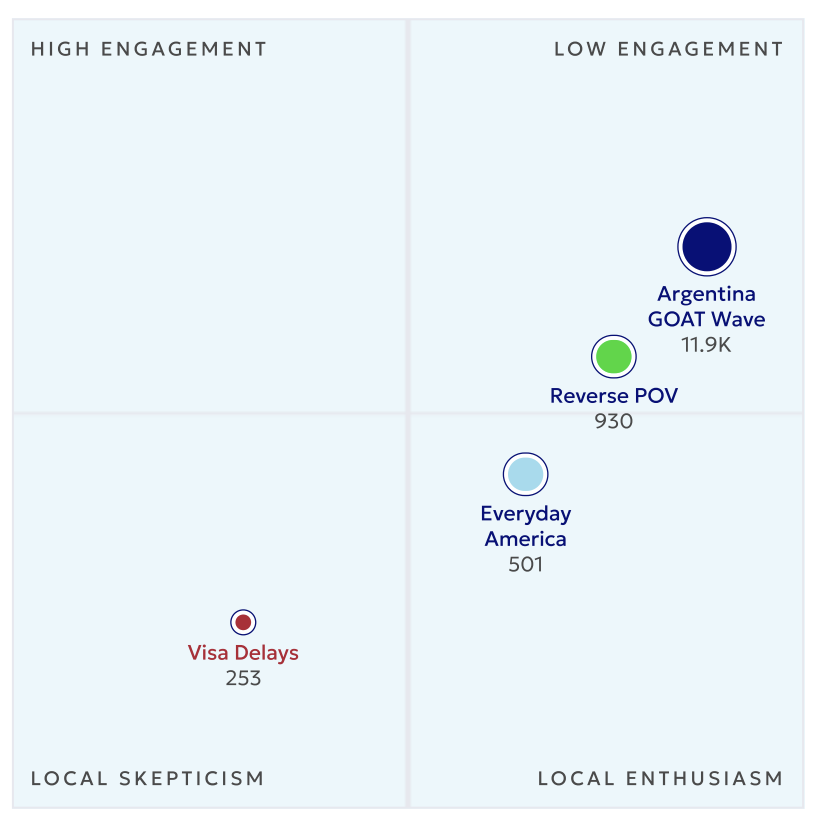
The Argentina wave is real — 13,300 records worth of Messi celebrations, local alignment, and viral fan moments. Brands have noticed. They're piling in. But there's a 930-record cluster sitting in the data that almost nobody is touching, and it's generating higher emotional resonance per post than anything else we tracked. Locals documenting their own discovery of foreign fan rituals — learning Scottish chants in Boston pubs, witnessing Japanese stadium cleanups in real time — outperforms generic stadium content on every engagement metric.
The viral opportunity of the 2026 World Cup isn't foreign fans reacting to America. It's Americans reacting to the world.

What the data actually showed
1. The Reverse POV is massively underindexed. Only 930 records captured the local-discovery angle — versus 13,300 on fan support and star focus. When locals do document their reactions to foreign fan culture, engagement and emotional resonance spike sharply. This is a whitespace play, not a crowded trade. Brands can own this lane right now because almost no one is in it.
2. The Argentina/Messi wave is the highest-volume bet, but also the most competitive. With 11,900 records in the high-engagement, high-local-enthusiasm quadrant, Argentine fan content is the safe, reliable choice — massive volume, positive sentiment, proven cultural heat. The trade-off: it's the most commercialized space in the dataset. Official FIFA partners are already saturating it.
3. Food and hospitality are doing cultural heavy lifting no one is claiming. Texas BBQ joints, Boston pubs, Times Square food trucks — 14,300 multifaceted event records show cross-cultural interaction clustering heavily around regional food and local service. Visitors express genuine surprise at American warmth and hospitality. Local tourism boards and food brands are leaving a high-resonance narrative completely unsponsored.
4. Visa friction is the concentrated negative pocket. With 253 records specifically on visa delays and a broader 14,300-record theme encompassing transit and logistics frustration, negative sentiment isn't random — it's targeted. Brands that align with official tournament infrastructure risk getting pulled into this conversation. Stay operationally neutral; focus on arrived fans, not access friction.
5. Official tournament music is getting roasted. 127 records on Cluster 27 document persistent fan disappointment with the tournament's official songs. Fans want Waka Waka energy, and the new tracks aren't delivering. Brands using licensed tournament audio in their content are starting with a credibility deficit.
WHAT A STANDARD TOOL WOULD HAVE MISSED
A keyword search on #WorldCup2026 returns a firehose of match scores, bracket debates, and political visa commentary — none of which belongs in a brand campaign brief. Discover's semantic clustering isolated the cross-cultural exchange conversations from the sports noise, then separated "visitor reacts to America" content from "American reacts to visitor" content. Those are two distinct behavioral clusters with completely different engagement profiles.
Standard listening would have lumped them together and called it "cultural exchange." Discover found the 930-record whitespace that's currently sitting unclaimed.
Three choices — not ten instructions
A. Build a Reverse POV creator network before the quarterfinals. The window to own this lane is now. Deploy local creators to pubs and fan zones in Boston, Dallas, and Houston with one brief: document their genuine reaction to foreign fan rituals. Learning a chant. Witnessing a stadium cleanup. No script, no polish. The 930 records show this content is emotionally resonant precisely because it doesn't feel produced.
B. Anchor around food, not stadium footage. The data shows regional food and hospitality are the primary cultural bridges — and they're unsponsored. A "First Taste" video series featuring visiting fans trying Texas BBQ or local pub food is a low-cost, high-resonance play. Local tourism boards and food brands have a short window to own this before the final.
C. Partner with domestic creators, not visiting influencers. Visiting content creators are operating under real legal risk — US authorities have clarified that monetized content on tourist visas is technically prohibited. Brands that co-produce with domestic creators sidestep the compliance issue entirely and still capture the cross-cultural dynamic. It's the cleaner, faster, and legally defensible play.
ABOUT THIS REPORT
This report was produced using Tellagence Discover, a contextual intelligence platform. Contextual intelligence is the discipline of surfacing specific, sized, and human insights from large volumes of unstructured data — going beyond the obvious AI summary to find what the data actually means, not just what it says. Discover analyzed 31,100 records across social, blog, and news sources using a custom semantic clustering engine, achieving a 94.8% confidence score. All reports are produced by the Tellagence research team.